Now that you’ve explored our Deep Ocean Explorer Simulator, discover how this technology connects to real-world science and The US Navy!
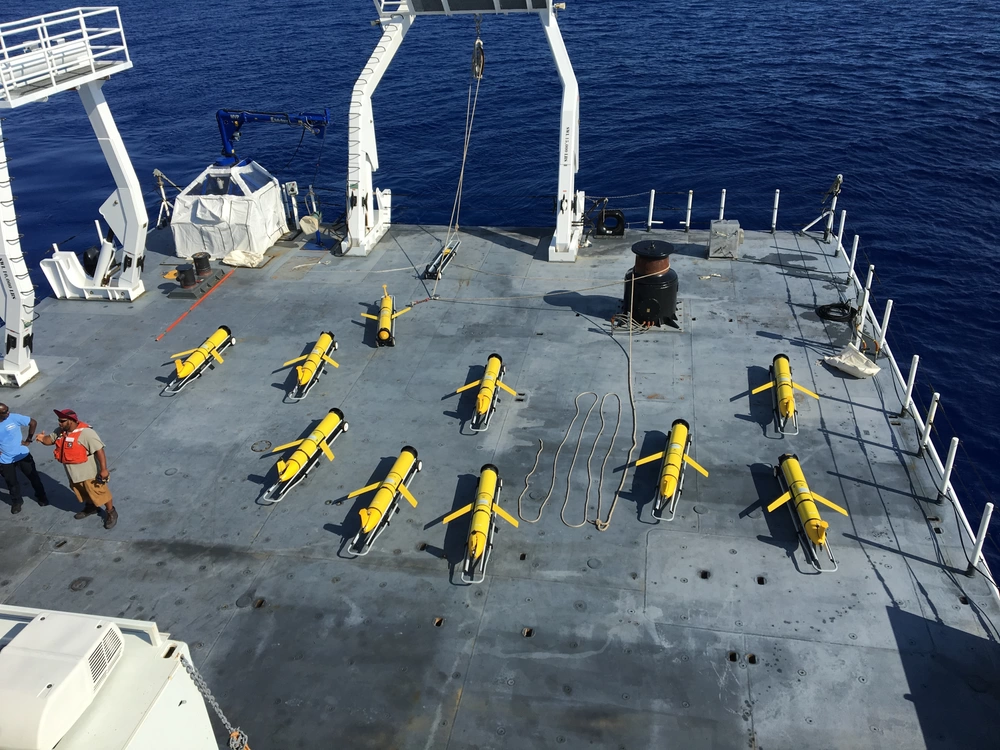
The U.S. Navy Meteorology and Oceanography Commands are located at Stennis Space Center. Of those commands, the Naval Oceanographic Office (NAVO) collects, monitors, and predicts changing oceanographic conditions much like a meteorologist does with weather information. Think of the Navy’s oceanographers as weather forecasters for the sea! Data gained, such as information about the water, ocean depth and terrain, and seabed (bottom composition), is used by NAVO. This important information creates a better understanding of the environment for the Navy, such as how Navy ships and underwater vehicles will be affected by the ocean. Knowing how the ocean works helps scientists to keep ships and sailors safe. Its like solving a giant ocean puzzle! Data collected by NAVO is used in oceanographic models that scientists at the Fleet Numerical Oceanography and Meteorology Center run daily to predict ocean movements. They use powerful supercomputers at the Defense Supercomputing Resource Center to predict what the ocean will be like tomorrow, next week, or even next month. The results of this high-performing computing allow Navy oceanographers to provide highly accurate and important ocean information into the hands of Naval forces conducting operations above, on, or below the ocean.
At the Naval Research Laboratory – Stennis Detachment, is where scientists develop new ocean models and new techniques (called algorithms) within models, so the predictions used by the Navy become more accurate. If you love computers, math, science, and the ocean, this could be the career for you! Here are just a few of the jobs that help the Navy understand and predict the ocean:
Some of the jobs involved in this exciting work include:
● Oceanographer: Study the ocean and its secrets! ● Data Scientist: Analyze the information gathered! ● Remote Vehicle Operator: Pilot underwater robots! ● Meteorologist: Understand the weather at sea! ● Geologist: Explore the ocean floor! ● Computer Scientist: Keep the computers running! ● Mathematician: Use math to understand the data! ● Acoustician: Study sound in the ocean! ● And many more STEM-related careers!